

Your SDLC needs a productivity context engine
The brief, brilliant flight of Fable 5, tech leaders turn to model routing, and coping with AI rockstars

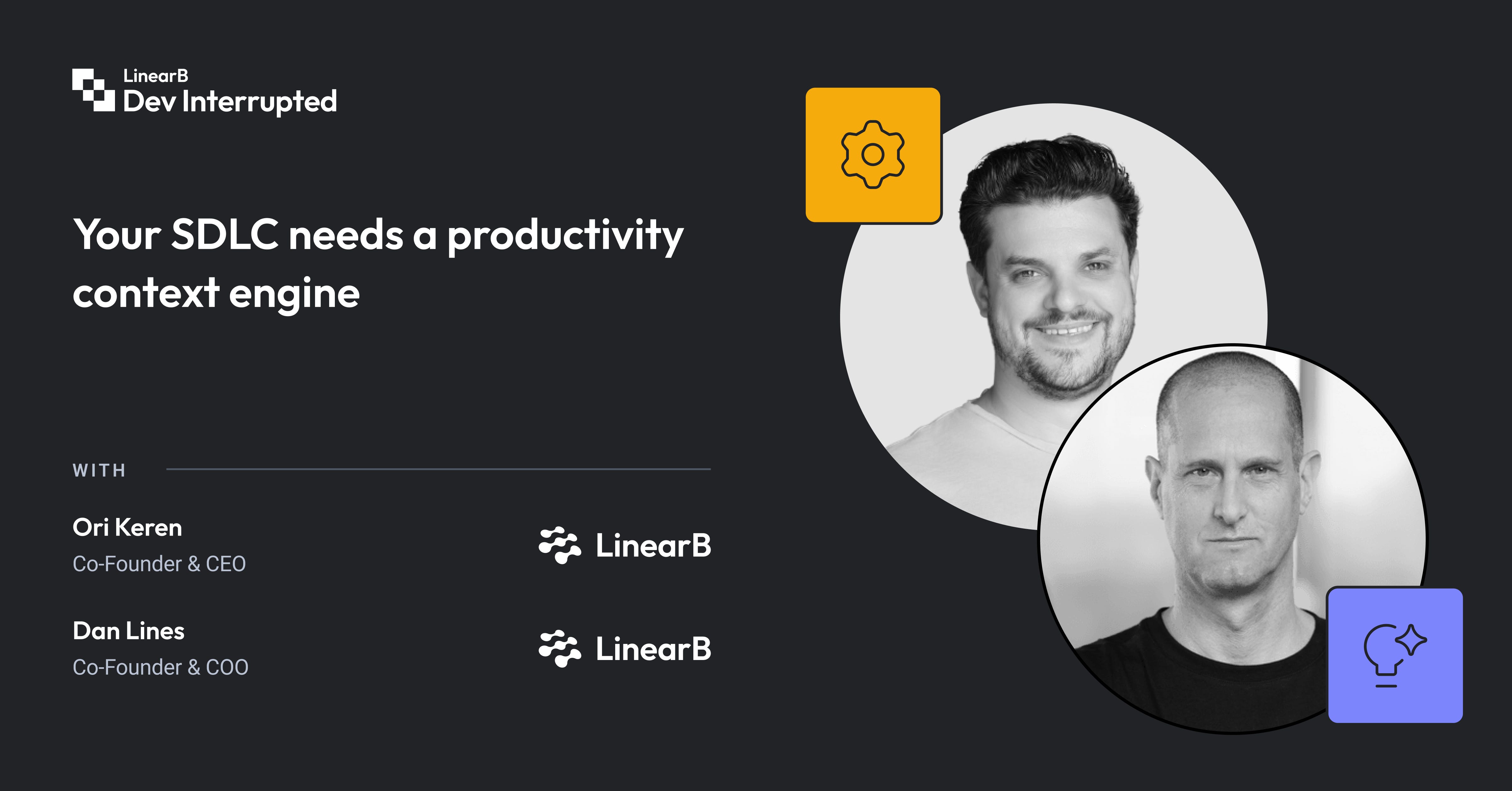
What if the secret to improving your agentic SDLC is not a better coding model, but a smarter engineering context engine? This week on Dev Interrupted, LinearB founders Ori Keren and Dan Lines join the show to discuss the messy middle of AI adoption and the painful transition from the traditional SDLC to the Agentic Development Life Cycle. They unpack why the era of cheap AI experimentation is over, how rising token costs are forcing engineering leaders to prioritize strict business ROI, and how autonomous tools are fundamentally changing the daily workflow of developers.
1. The brief, brilliant flight of Fable 5
Anthropic has a habit of dropping massive updates right as we finish recording, but I managed to spend 72 straight hours maxing out my sessions with the newly released Claude Fable 5. If riding Sonnet is like riding a bicycle and Opus is a horse, using a Mythos class model feels like harnessing a dragon. Unfortunately, the US government stepped in over the weekend and issued an export control directive citing national security concerns. This forced Anthropic to abruptly disable public access to both Fable 5 and Mythos 5, meaning our limited window to harness that power and audit our systems has closed for the time being.
Read: Statement on the US government directive to suspend access to Fable 5 and Mythos 5

2. What it actually feels like to wield Mythos
To truly understand the capability jump of the Mythos models, you have to look at how they approach problem solving. Fable is exceptionally good at spinning up adversarial sub-agents that actively challenge your situation rather than just blindly following prompts. Ethan Mollick recently demonstrated this by guiding the model to generate a complex isochronic map, a task requiring it to natively understand flight patterns and off road travel times. While these models dramatically reduce the effort needed to build complex software, you still need domain experts to ensure the outputs are secure and production ready.
Read: What it feels like to work with Mythos

3. Sobering up your AI rockstar developers
AI has lowered the floor and raised the ceiling for becoming a rockstar developer. We all know the classic rockstar trope: they roll into your codebase, ship a massive, clever solution before lunch, and then bounce, leaving the rest of the team to maintain a fragile Jenga tower. AI agents are currently magnifying this exact problem at scale. As I argued on the podcast, we need to sober up these autonomous rockstars by slowing them down and forcing them to produce incremental, reviewable snippets. We must throw guardrails in front of these tools to ensure human domain experts remain firmly in the driver’s seat.
Read: Cleaning up after AI rockstar developers

4. The unsustainable reality of tokenmaxxing
Token consumption has officially been gamified. Sam Altman recently revealed that OpenAI’s top spender is burning through 100 billion tokens a month, and the median user today is consuming what the absolute top users were spending just six years ago. My co-host Ben Lloyd Pearson correctly pointed out that companies have a financial incentive to encourage this behavior, but burning millions of dollars on tokens without clear ROI is completely unsustainable. Measuring developer success strictly by token consumption is a directionless metric that we need to leave behind.

5. Life beyond tokenmaxxing
Your team is generating more code than ever before, but is your delivery actually getting faster? When AI speeds up code generation, it often shifts bottlenecks downstream to review and deployment, leaving your system lopsided.
Stop relying on code volume metrics and falling into the tokenmaxxing trap. Join Ben and I for a 45-minute workshop on June 25 to discover how to measure AI’s real impact across the SDLC. You will get the exact operational model you need to answer board-level ROI questions, plus first access to our new guide on measuring AI efficiency.

6. How to actually cut your AI spend in half
If tokenmaxxing is dying, model routing is the secret to what comes next. You do not need to use a dragon class model just to run a simple script or rename a file. This excellent piece from OnlyCFO acts as a Rosetta Stone between engineering and finance leaders, proving that intelligently routing workflows to smaller, cheaper models like Haiku can dramatically cut costs. We need to start optimizing for cost efficiency just as rigorously as we optimize for accuracy, and that starts with putting proper routing architecture in place.
Read: How I Cut Our AI Spend in Half | “Tokenmaxxing” is Dead

7. The internet belongs to the bots now
We have reached a tipping point where bots officially account for more than half of all internet traffic. As we discussed on the show, this shift fundamentally changes how we view security threats and web archiving. When AI generated websites become the primary training data for the next generation of models, you end up with an exhaust pipe feeding the production input. We risk losing human diversity in our training sets, and engineering leaders need to start rethinking what audience traffic and security actually mean in a bot majority world.
Read: Bots Have Officially Taken Over the Internet, Humans Are The Minority

That's a great read! Thank you!