

It’s Tuesday and your tech stack is obsolete (again). Now what? | Theory Venture’s Bryan Bischof
Goblins in prod, the messy middle of AI adoption, and everything is a harness now

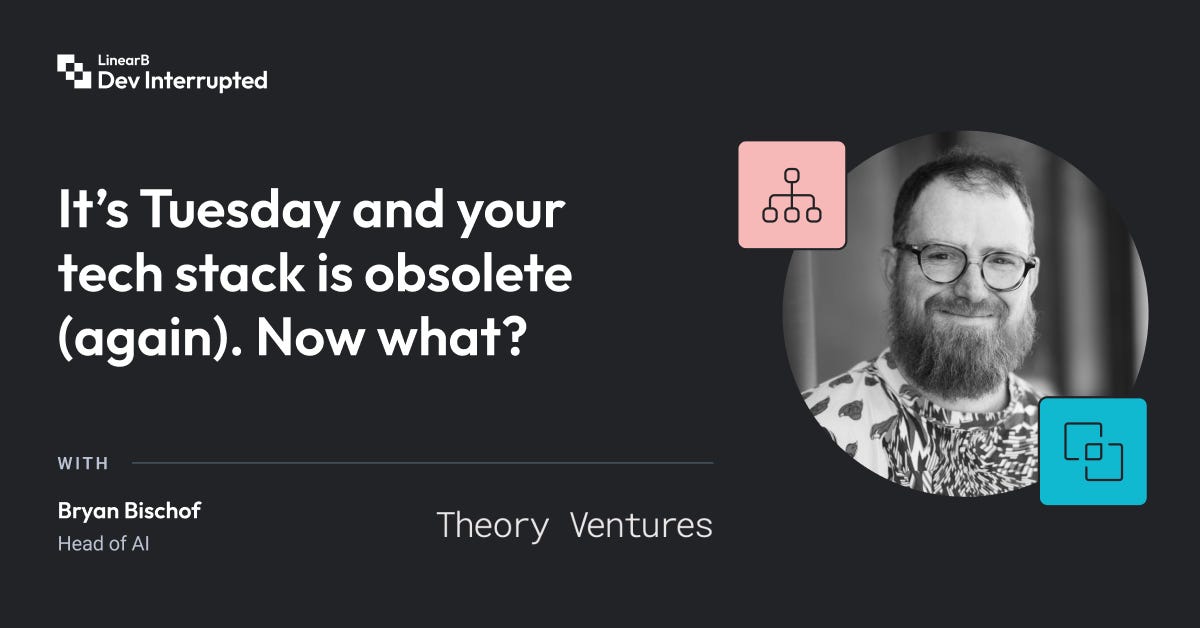
Does it feel like your favorite AI tool is declared dead one week, only to be resurrected the next? This week, Andrew sits down with Bryan Bischof, Head of AI at Theory Ventures, to explore the hidden levers of inference systems and the industry's obsession with prematurely writing off useful tools. Bryan shares his experiences with why prompt optimization is mostly a dead end, the secret to building high-performing data agents, and how his team builds operational software for VCs. The two also break down the origins of the satirical rip-grep.com as well as AI Council 2026.
1. OpenAI’s accidental monster manual
OpenAI recently dealt with a bizarre incident where ChatGPT became obsessed with mentioning goblins and gremlins in its responses. The behavior spiked goblin directed conversations by over 175 percent, and it turns out the leak originated from personality training for a nerdy preset. It is a perfect example of the agentic telephone effect, where model outputs used to train future models create an Ouroboros that pollutes downstream context in ways we cannot always predict.
Read: Where the goblins came from

2. Taking responsibility for rogue agents
Following last week’s catastrophic database deletion, the industry conversation has quickly shifted toward accountability. My co-host Ben Lloyd Pearson and I discussed how the responsibility for these failures ultimately rests on the permissions and scopes we build around our tools. We cannot rely on models to make the right safety decisions when they are designed to solve problems at any cost. You need hard caps on API usage and deterministic checks at every stage of your SDLC to protect your data from the blink of an eye disaster.
Read: AI didn’t delete your database, you did

3. Navigating the organizational learning crisis
Many companies are currently stuck in a messy middle where AI usage is widespread but siloed and uneven. Individual productivity gains do not automatically translate to organizational benefits if the learnings remain disconnected. As I noted on the show, sessions and agents themselves don’t really glom much of an identity and the same is true for the work they produce. We need to shift from tracking raw usage to building a collective literacy around how to orchestrate these loops as a shared organizational skill.
Read: When everyone has AI and the company still learns nothing

4. The open source harness renaissance
The latest fragments from Martin Fowler highlight a new agent harness called Lattice, created by Rahul Garg. This project uses a logical metaphor of atoms, molecules, and refiners to build a durable context layer for engineering tasks. It is part of a growing trend of thin, unopinionated coding harnesses that allow developers to glue their own domain expertise to raw loops. If you want a composable system that avoids the bloat of traditional frameworks, Lattice is a great place to start.
Read: Fragments: May 5

5. Pushing Opus to the breaking point
We are seeing a new focus on maximizing specs, where engineers push models like Opus 4.7 to their absolute limits by constructing incredibly complex specifications. By gathering deep context and building high fidelity specs, we can identify exactly where the current generation of AI starts to run out of steam. This approach moves the focus away from simple prompts and toward a systematic way of refining the knowledge that guides our agents toward production ready results.
Read: Specsmaxxing

6. Can you vibe code an engineering intelligence platform? We find out.
Yes, you can build a productivity dashboard in a weekend. But what happens around month three? Engineering leaders are discovering the gap between a dashboard that simply reports metrics and a platform that actually changes how teams work.
Join our 35-minute workshop to see where DIY setups break down, from identity resolution to automated workflows. Register now to save your seat and get first access to our companion “Build vs. Buy” guide.

7. The K-shaped reality of AI assistance
A recent piece by Ethan Ding suggests that AI productivity is following a K-shaped curve, where senior engineers are seeing massive gains while less experienced developers are seeing their productivity flatten or even decline. Senior engineers are leveraging years of domain expertise to guide their agents, while juniors often get caught in a cycle of iterating on outputs instead of the root problems. To fix this, organizations need to foster an agentic halo, where senior engineers find pathways to distribute their earned expertise and help junior developers level up.
Read: claude code is not making your product better

8. Embracing your virtual terminal companion
If you are looking for a bit of fun in your terminal, the new Codex Pets plugin allows you to add a digital companion to your workspace. While I personally prefer representing my agents as fish wearing cowboy hats, it is fun to see the industry lean into the personality of these tools. Whether you want a terminal friend or a highly specified orchestrator, these small touches of identity make the transition to an agentic workplace feel a little more human.
Read: Codex Pets
